
Time ticks on
February already! Where did the time go? Days blurred into each other for the want of novelty and difference. Time for a reset.

Enabling The How #246. Reading time: 5 minutes, 44 seconds
And then it was February. A full, particularly long month of the year has come and gone. Time ticks on relentlessly, stopping for no-one and no thing.
Of course as we get older it feels as if time speeds up. A year becomes a smaller fraction of our total life. A year for a 5-year-old is 20% of their life, but for a 50-year-old, it’s only 2%. This shrinking proportion of a year to total life makes each year feel shorter.
As we get older life becomes more routine. There are fewer new things to anchor our memory so our days blend into each other. Childhood, on the other hand, is full of first-time experiences (first day of school, first bike ride). These create vivid, memorable moments that make time feel slower.
The wonderful thing is we can stop time speeding up by bringing new experiences into our lives and by living mindfully.
At most three things
When we looked back at last week, there were at most three things that came up without delving into our calendars to remind ourselves of what we had actually experienced. What stood out for Chantal was a particularly positive meeting with a client, a visit to the dermatologist and a happy wine tasting and dinner.
The meeting with the client was memorable because one party has a long association with Matthew and there is real potential for partnership. Chantal seldom visits any doctor, so the dermatologist was a novel experience, and not one that she necessarily wants to repeat. The wine tasting took place at the end of the week and is remembered for the taste of new wines, light conversation and a delicious dinner.
For Matthew the positive client meeting came to mind, as did a successful first coaching session with a new client and the wine tasting.
The rest of the week was a blur and yes, it went by very quickly.
Time feels contracted
Speaking to a friend, Chantal said, “This year time feels as if it has contracted. It feels as if I cannot get as much done in a day as I used to.”
Chantal realised that in the past the day was broken up by car trips to meetings that were face to face. Even a pop out to the shops for DIY odds and ends, or a coffee catch up with a friend, maybe even a pedicure. Lately these have dwindled partly as a result of a level of anxiety to attend to work. The logic being the more one focuses on work the more one will get done.
This has not been the case. It seems counter intuitive but fewer breaks, fewer changes in the daily routine, have resulted in it feeling less productive.
“I don’t think I did less,” continued Chantal, “What I did just didn’t feel very significant.”
Concentrated bursts of activity with deeper focus and intent feel more substantial and are more easily remembered when reflecting back on the day. It feels fuller and more satisfying.

More walking and talking
We did more walking last week than we have in a long time. As a result of the large mole that was cut from Chantal’s back, yoga was a no-go for four days.
“I can’t do nothing,” said Chantal on the morning after the mole removal, “I’m going for a walk, want to join me?”
Matthew was happy to walk. Morning walks used to be a staple of ours. We would take umbrellas in case it rained while walking, and even freezing temperatures in winter did not put us off.
For some reason we stopped walking as much in the morning and started doing short walks in the afternoon. With summer came the afternoon rains which stopped us in our tracks. Along with hunkering down in the office cave all day, we stopped venturing out for walks. We cloistered ourselves in the same space for longer blurs of time.
We walked every morning while the “mole hole” healed. The exercise was great but the opportunity to spend a good hour talking and connecting was even better.
You’d think that because we work in the same office, literally at the same desk, that we would talk all day. We don’t, we get on with our tasks and jobs. In our own little work bubbles.
It feels silly to set up meetings to talk to each other but that’s what it can take to stop, turn and talk. Walking and talking is so much better.
Bring colour and variety to our days
As we moved into the second month of 2026 we appreciated the need to make some changes that would bring colour and variety to our days. We don’t want to feel as if time is rushing by while we are bouncing along like dead leaves in the wind.
We want to stretch out the sunlit hours and relish in the good that we do and the value that we bring. We want to dot the nights with music and art like we used to.
We want to be more like Leah who, not yet two, giggles at a funny face and is awed by a bunch of wild flowers. Her brain is a sponge for the new and the novel. She gravitates to it like a magnet. As she grows so more is revealed to her simply because she can reach and see things that last week she could not!
We want to be able to cast our minds back on our days and weeks and remember more than three things. We want to capture with fondness and delight our moments of mirth, when an “ah-hah” landed or a ‘Wow” left our lips.
If you consider what stood out for you last week, what comes up? More than three things? If you want time to slow down, what can you do to bring colour and variety into your hours? What can you do to taste the tip of the day and toast that ribbon of something different that you drew into it, wrapping it in a bow of a memory?
Until next time.
Yours in feeling,
Matthew & Chantal
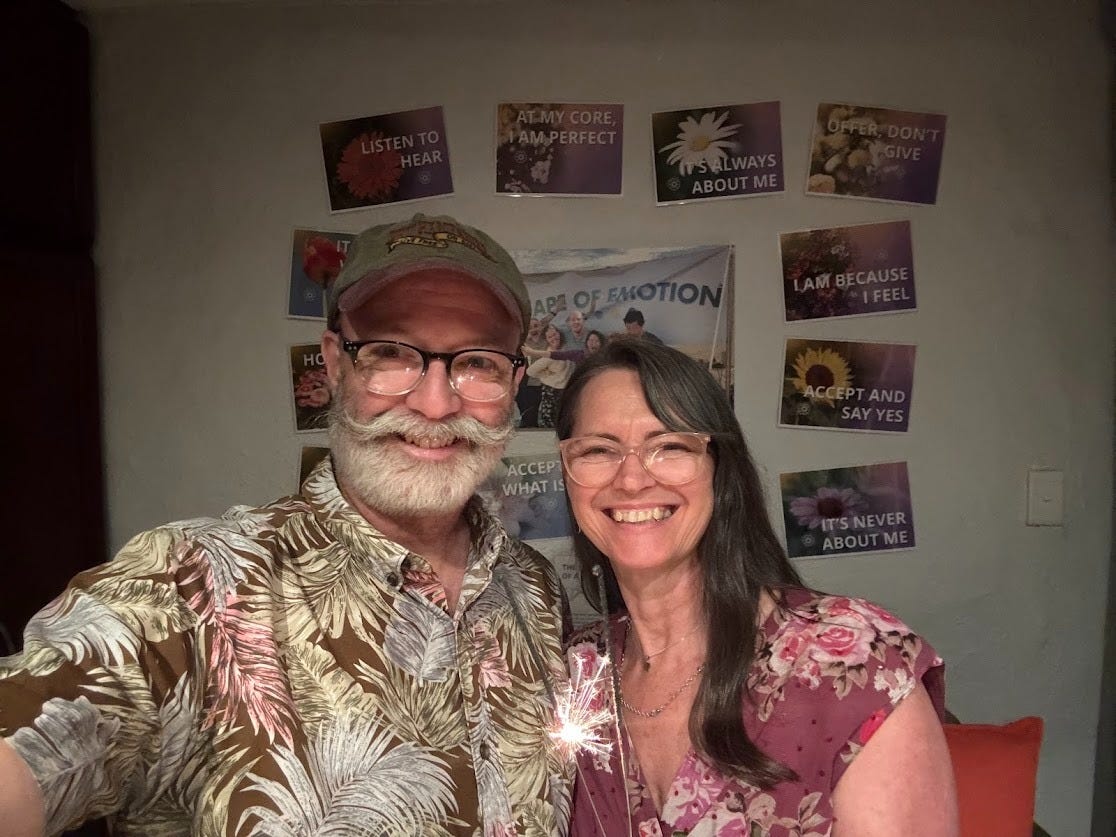
Eight years of Shape of Emotion
For the greater part of 2017 we had sat with a question that had no easy answer.
South Africa had the lowest mental health score in the world. Over 17 million diagnosed anxiety disorders in a population of 58 million. 2.8 psychologists per 100,000 people. Eighteen million citizens living at a poverty threshold of $1.90 a day. A country shaped by slavery, colonialism, Apartheid, civil unrest, and ongoing economic collapse.
The maths of the prevailing model simply did not work. One therapist. One patient. One hour. Repeat. There were not enough therapists. There would never be enough therapists. And the children arriving at school every morning, locked in fight-or-flight from the violence and poverty surrounding them, could not learn. Education was supposed to be the way out. But education requires a brain that is online, and a nervous system in survival mode takes that offline.
And so we asked the question: What if we could build something different? Something that works with children and adults. Something that works in groups. An African solution for an African problem.
We had no idea if it was even possible.
On 3 February 2018 in a small room in Linden, Johannesburg we presented Shape of Emotion to a small group of people at a pilot workshop.
Eight years later, Shape of Emotion has been used with people from all over the world. It works and both the world and the science is beginning to finally catch up.
Here’s our homage to Shape of Emotion on its eighth birthday.

IMAGE CREDITS FOR THIS ISSUE: 5TH PLACE